Assessing and Reporting at Hall-Dale High School
(Click Here For the Student & Parent Grading Guide)
What is the
purpose of grading at Hall-Dale High School?
The purpose of
grading is to measure student success and communicate progress toward
being proficient in the standards described in our curriculum, and to do
so in such a way to encourage learning. “Assessment for learning” means
that assessment is used to tailor our teaching plans and our teaching
style to better help students achieve the standards in our classrooms,
and to provide information for individualized plans or interventions
when needed. Not all kids learn the same nor do they learn in the same
amount of time. The grading practices of teachers should be transparent
and public and verbal or written progress reports should be shared with
students often. The goal should be to help students feel they have
earned, rather than been given, the final grade.
What is standards-based grading?
Standards
based grading is a grading system that evaluates student performance on
objective criteria (standards) describing essential skills and
knowledge. Hall-Dale High Schools standards were written by committees
representing each of the eight content areas of the Maine Learning
Results. Every Hall- Dale faculty member K-12 has contributed to this
process. The Hall-Dale science standards, for example, were written by a
committee of all the science teachers of the district’s science
teachers along
with elementary teachers focused on science. These
standards strongly reference the 2007 Maine Learning Results (MLR). The
point of the standards is to spell out what our students should know and
be able to do as they move through the 6 through 12 grade sequence,
culminating in graduation from high school. In a standards-based grading
system, a student’s achievement level is determined by his or her
performance on the individual standards.
What is the role of the teacher in grading?
Teacher
judgment is at the heart of grading. Judgment is used in a variety of
ways: when assessments are created, rubrics are written, scores are determined. In whatever manner teachers use their judgment, they are
encouraged to err on the side of the student. However a teacher uses
their judgment, the following guidelines are essential: (1) when a
teacher enters a score into Infinite Campus for a student’s record, he
or she is satisfied that it is a fair and accurate representation of
student performance, (2) the teacher has followed the faculty grading
guide recommendations and requirements, and (3) there is
agreement and support for reporting practices based on a consensus
understanding within departments.
How do you determine a grade
for an assessment?
All assessments should be scored on the
following four-point scale:
4 = Proficient with Distinction: The student’s work includes complexity, sophistication, originality, depth, synthesis or application that clearly exceeds what would be expected to meet the standards in this assessment. The work may not be perfect.
3 = Proficient: The student’s work fundamentally meets the standard being assessed and the assessment requirements.
2 = Partially Proficient: The student has demonstrated a substantive attempt to meet the standards but needs more time or effort to achieve competency.
1 = Not Proficient: The student does not demonstrate understanding or did not attempt the assessment.
When using standards based grading, a grade may only be assigned if there is an equivalent description of performance. The number is a numerical representation of a student’s performance (what they know and can do). The number has no meaning, unless it is associated (via the rubric) with a description of performance. If a student fails to complete and turn in an assessment, the teacher’s proper grading response should be to mark the assessment as incomplete under the academic standards being measured and to record a “1” on the associated work ethic standard.
Click here to view two examples of a rubric
How do scores track from
assessments, to trimester grades and then to the transcript?
Using
rubrics, students earn scores from assessments on individual content
standards. These scores are used when a teacher reports a trimester
grade. Trending is utilized, with emphasis on the most recent
achievement, to inform the reported grade. If there is not sufficient
data available to create a trend, no grade is likely to be reported in
that trimester.
Trimester
Grade Example:
ALGEBRA 2 CONTENT STANDARDS ASSESSMENT
SCORES TRIMESTER GRADE
Algebra Concepts 3 3 3 - 3
Numerations/Computation 2
2 3 2 2
Data 2 - - - n/a
Click here to view an Example of a Report Card
At the conclusion of the
course, the teacher reports the final level of achievement for each
content standard in the course. These final standards grades are then
averaged to create the final course grade which is posted to the
transcript and serves as the basis for GPA and class rank. Students must
earn a 2.5 or better as a final course grade to earn credit.
Final Course Grade Example:
ALGEBRA 2
CONTENT
STANDARDS FINAL
STANDARDS GRADES
Numerations/Computation
3
Data
2
FINAL COURSE GRADE 3.00
(posted to transcript)
Click here to view an Example of a Transcript
Click here to view the School Profile
The Separation of Grades, Work Ethic, and Behavior.
The Separation of Grades is an essential part of the Standards Based Educational System...
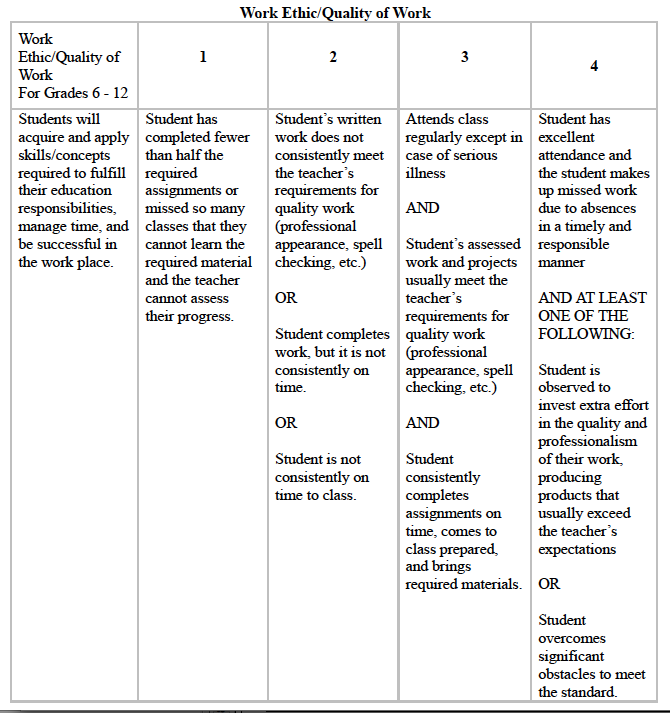
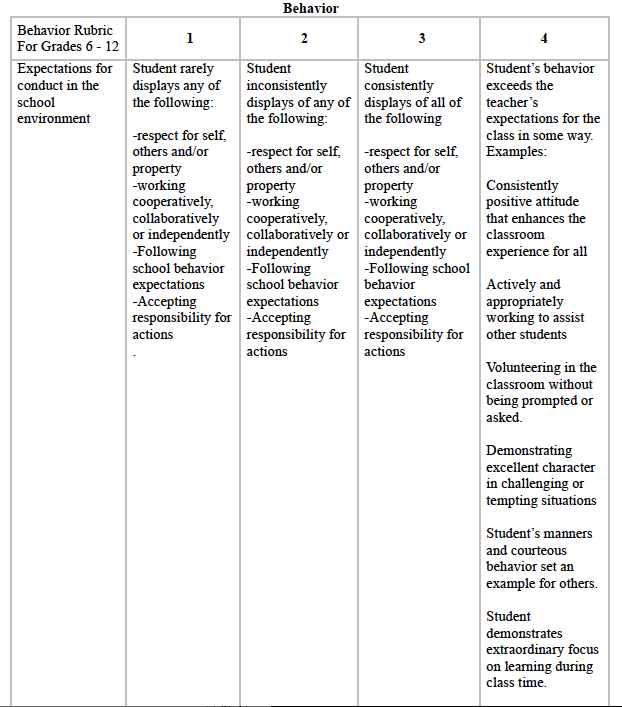
What is the role of Work Ethic and Behavior in this grading system?
Because a standards-based reporting system is based on proficiency, it’s important to separate work ethic and behavior out from the content standards. In each class, each trimester, students will receive a work ethic and behavior score. By reporting these scores, we’re hoping to give more information to parents and students regarding academic performance as well as information on student behavior. In order to achieve honor roll status, a student must achieve a ‘3’ or higher in all work ethic and behavior standards. Any ‘2’ will preclude a student from achieving honor roll status.